

FEB UNS Organizes Sharing Session for UNS Global Challenge 2026
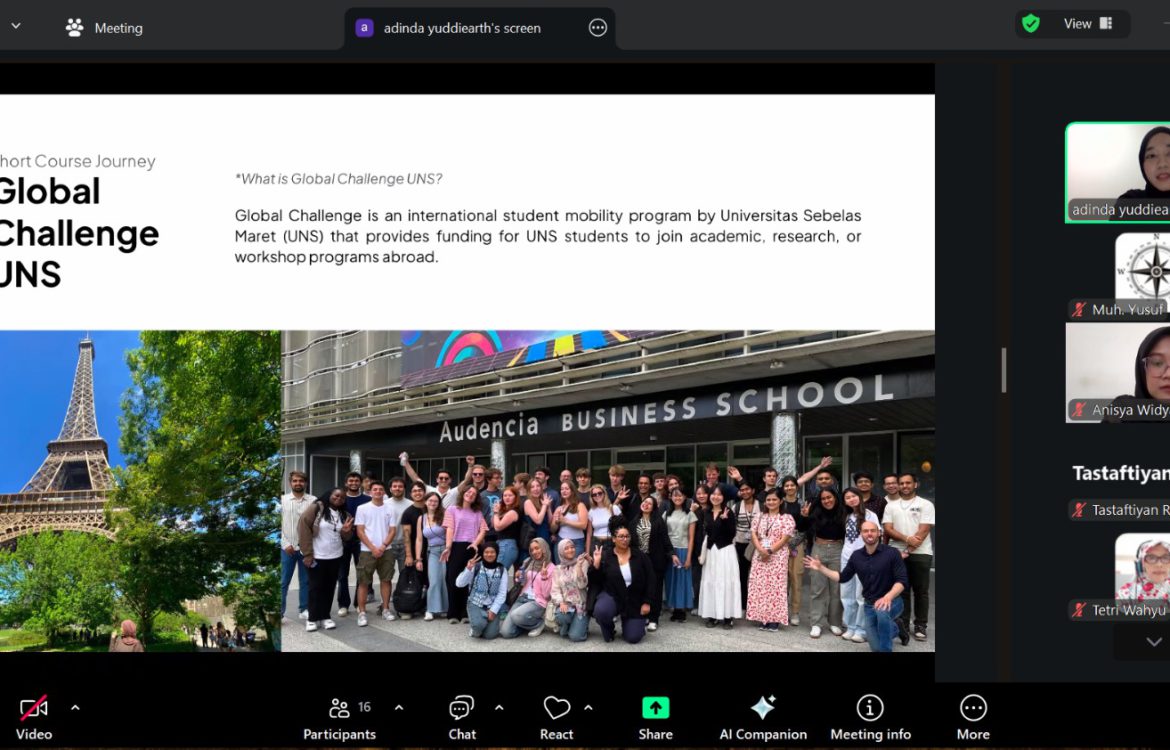
Faculty of Economics and Business (FEB), Universitas Sebelas Maret (UNS), organizes Sharing Session for UNS Global Challenge 2026 to strengthen students’ readiness for international mobility programs. The session is conducted virtually on Friday, 14 November 2025, featuring Tastaftiyan Risfandy, S.E., M.Sc., Ph.D., Vice Dean for Student and Alumni Affairs at FEB UNS, and Adinda Yuddiearth, a Development Economics student and Awardee of the 2025 UNS Global Challenge program at Audencia Business School, France.
Tastaftiyan Risfandy, Ph.D., provides a comprehensive explanation of the requirements, timeline, and selection procedures both for the university-level and faculty-level registration pathways. For the university-level pathway, the provision states that applicant should be an active student status of at least the third semester. Additionally, they must provide a Letter of Acceptance from partner universities and a proof of English proficiency (optional). The program is scheduled for April–July 2026 and providing a fully funded scheme options.
Meanwhile, the faculty-level pathway targets students from the sixth semester (at least) and requires proof of English proficiency, where the selection process consists of two interview stages. This faculty-level pathway program runs from April to September 2026 with co-funding or fully funded schemes.
Tastaftiyan also outlines the complete timeline, ranging from registration and selection processes to announcement and final report submission. Additionally, students receive information regarding funding components, including airfare, visa fees, and living allowance for selected participants according to each pathway’s provisions. This dissemination is intended to provide students with a comprehensive understanding for the academic planning, administrative preparation, and strategies to maximize their chances of admission into the program.
The second speaker, Adinda, shares her experience participating in the Short Course on Cross Cultural Management at Audencia Business School, France, held from 23 to 27 June. By participating in the program she gains intensive learning combining theory, case studies, class discussions, and group projects with students from various countries. The multicultural learning environment offers her deep insights into how culture influences communication, work styles, and team dynamics in global economic and business contexts.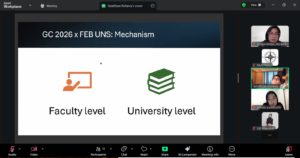
“The class was super insightful and meaningful. The mentor was truly an expert in the field. The sessions were highly interactive, with workshops, case discussion groups, and a final individual presentation on the last day. The class was incredibly diverse, with participants from Brazil, Hong Kong, the UK, Ukraine, France, and the Netherlands. Participants are coming from various majors, not only economics but also politics and science. This diversity leads to a wide range of perspectives in the discussion session. I learned that the more diverse an environment is—whether in school or business—the greater the perspectives that help us grow,” she explained.
In her presentation, Adinda also describes the preparation steps she does before joining the program, including compiling required documents, preparing an activity plan relevant to her academic field, conducting research on the host university, and managing technical preparations such as budgeting and academic scheduling.
“I highly recommend organizing everything thoroughly. I used spreadsheets and Notion to list countries, universities, and open programs, and to track which institutions had been contacted, including the email content. Some universities do not list their short courses on their websites, or the information is hard to find. Therefore, students need to contact the universities directly to confirm availability and alignment with the Global Challenge timeline,” she said.
She also shares several recommendations for students interested in international programs, such as preparing the Letter of Acceptance well in advance, selecting programs aligned with academic goals, and maintaining good communication with the UNS International Office.
This activity reinforces UNS’s commitment to advancing internationalization and enhancing student capacity through global learning experiences. The program also aligns with SDG 4 (Quality Education) by strengthening learning quality through international exposure, and SDG 17 (Partnerships for the Goals) through expanded collaboration with global educational institutions.