

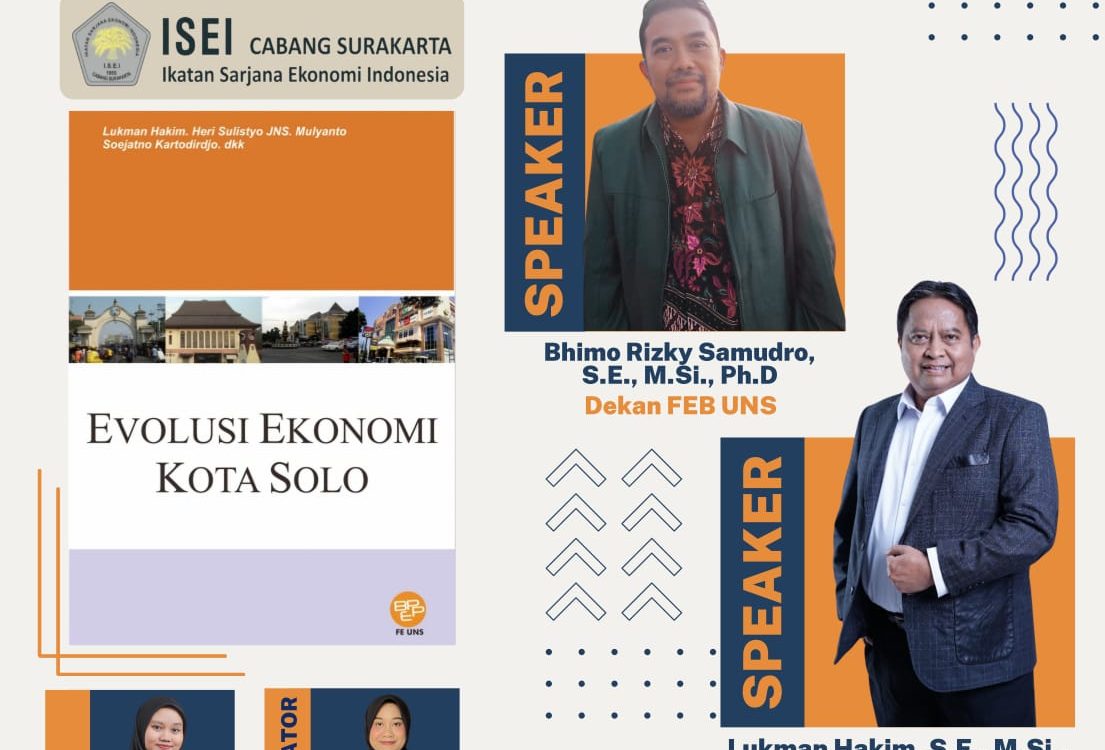
Book Talk: the Evolution of Solo’s Economy Features Two FEB UNS Faculty Members
Two faculty members from the Faculty of Economics and Business (FEB), Universitas Sebelas Maret (UNS), Lukman Hakim, S.E., M.Si., Ph.D., and Bhimo Rizky Samudro, S.E., M.Si., Ph.D., served as invited speakers in the Book Talk entitled ‘Evolusi Ekonomi Kota Solo (The Evolution of Solo’s Economy)’ on Wednesday, 11 December 2024. The event took place at the Suhardi Hall of FEB UNS and was organized by the Regional Office of the Indonesian Economic Scholars Association (ISEI) in Surakarta. More than 100 participants attended the session, including members of GenBI (Generasi Baru Indonesia), a student organization of Bank Indonesia scholarship recipients committed to becoming role models, agents of change, and frontliners in disseminating information from Bank Indonesia to the public.
In his presentation, Bhimo Rizky Samudro explained that ‘Evolusi Ekonomi Kota Solo’ was a collaborative publication authored by Lukman Hakim, Hery Sulistyo JNS, Mulyanto, Soejatno Kartodirjo, and others. The book explores Solo’s economic development over time, highlighting how the city’s economy has changed through the integration of traditional and modern elements.
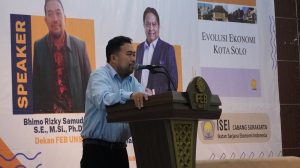 “This book describes the economic movement of Solo from the colonial period, the post-independence era, and into globalization and modernization. It also shows the local impacts of modernization,” stated Dr. Bhimo.
The book also outlines Solo’s economic history during the colonial period, particularly focusing on agriculture, such as rice and sugarcane, and the significance of batik as a major commodity. It covers infrastructure development during the Dutch period, such as railway construction. Additionally, it discusses the post-independence transformation from 1945 to the 1980s, including the growth of MSMEs in batik and textile sectors, urbanization, and the rise of small-scale industries.
 Solo is also positioned as a center of creative economy, marked by cultural festivals such as the Solo Batik Carnival and the revitalization of heritage areas including Pasar Gede and the Palace complex. Bhimo also noted the current challenges and opportunities facing the city: rapid urbanization and environmental pressures on one hand, and the digital transformation of MSMEs and tourism based on tradition on the other. He concluded that Solo has successfully maintained a balance between tradition and modernity, emphasizing the need for collaboration among the government, community, and business sectors.
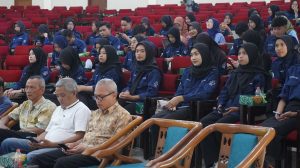 Dr. Lukman Hakim further elaborated that the book provides an analysis of the city’s economic evolution from the era of the royal kingdom to the current reform era. According to him, there are two main reasons why such a study is necessary. First, Solo holds a distinctive historical position as the seat of power in Javanese civilization. As the capital of the Mataram Islamic Kingdom, Solo has remained an important cultural center and regional trade hub in Indonesia. Second, studying Solo’s economic evolution offers insights into the roots of the city’s development and its transformation into what it is today, as well as a means to envision its future trajectory.
Lukman cited Dorodjatun Kuntjoro-Jakti (2000), who argued that history moves forward—not backward—and that society should neither romanticize the past as a “golden age” nor view it as a “dark era” that burdens the present. Instead, history should serve as a foundation for improving the capacity to anticipate the future.
The event also marked the inauguration of the ISEI UNS Chapter, chaired by Dr. Bhimo Rizky Samudro, Dean of FEB UNS. Additionally, ISEI Surakarta established a youth division, ISEI Muda, to accommodate young economics graduates. Aprilian Tri Setyan Wijaya, S.Ak., was appointed as its first chair.
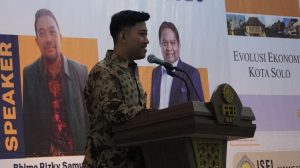 In his address, Aprilian stated that ISEI Muda is part of the broader ISEI organization, which is a major professional institution committed to advancing Indonesia’s economic resilience and development.“As a branch of ISEI, we in ISEI Muda are focusing on developing young economics alumni in Indonesia, particularly in Solo. We believe that the younger generation holds a strategic role in national economic development—whether through theory, research, or policy implementation with direct societal impact. On behalf of my fellow members, I would like to share our vision, mission, and goals for the future,” he explained.
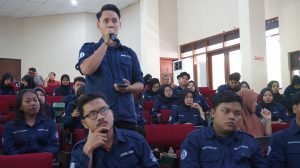 ISEI Muda’s vision includes three key initiatives. First, enhancing the role of ISEI Muda as a platform to sharpen members’ capabilities and skills. In this fast-changing era, economic challenges and opportunities are constantly evolving. Therefore, the younger generation must equip themselves with relevant knowledge and adaptive skills. Through seminars, discussions, training, and collaborative research, ISEI Muda aims to create learning opportunities and drive innovation.
Second, ISEI Muda plans to expand its network, both with local youth organizations in Solo and at the national level. Young economists should have broader access to information and become a bridge connecting academia, the workforce, and public policy.
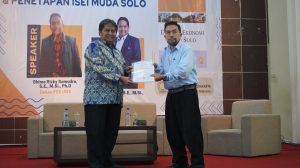 Third, ISEI Muda will actively engage in current socio-economic issues, from economic inequality and digital transformation to sustainability. The organization seeks to contribute with creative and forward-thinking perspectives.
“No journey can succeed without the support and encouragement of many parties, especially from our senior members in ISEI and our beloved FEB UNS. Therefore, I invite everyone to support and contribute to ISEI. I express my gratitude to the Solo Chapter for providing us with a strong foundation. We kindly ask for your blessings and support so that ISEI Muda may continue to contribute, bring renewed enthusiasm, and create a positive impact on the community, especially in Solo,” he concluded.